This year we went old school for the annual mowing of the wildflower meadow.
Our friends at the Wiltshire Wildlife Trust lent us some scythes and our volunteers got to work under the watchful supervision of Andy and Simon.
It was a new experience for most of us, a great full-body workout, and much fun was had by all. We’ll definitely be looking to do it again!
Andy provided cake again, and they were well deserved.
Thanks to all our lovely volunteers for turning out on another glorious HBUF morning. If you’d like to get involved, we meet on the first Sunday of every month, everyone welcome.
On Monday the 8th May we’ll be taking part in the Big Help Out, King Charles’ initiative to encourage more people to volunteer in their local communities.
On the day, volunteers will be given a tour of the site, to learn a little about our history and the type of tasks our volunteers get to do throughout the year.
That will be followed by a chance to get hands-on, building some ‘dead hedging’ to protect some of the local wildlife, and improving the habitat for some of our smaller residents.
It’s a great opportunity to get involved if you haven’t been out with us before, or to reconnect if you haven’t visited for a while.
To find out more, and to register, checkout our events page.
For the first volunteer day of 2023 we revisited the dead-hedge that we put in to protect some of our wildlife and gave it a bit of an upgrade.
Sadly, the original had suffered from being battered by stray footballs from the pitch next to it, and from unwanted human attention.
The new one, we hope, is a bit sturdier. Aside from the heavier posts and beams that are part of it we’ve also planted some willow cuttings taken from one of our trees. The hope is that these will take root and become a living part of the hedge that we can train to provide an even sturdier natural barrier. Not exactly a Whomping Willow but enough to fend off poor shots on goal!
We can’t help with football skills, but hopefully the new fence will withstand the off-target balls.
The day before we set out we heard that a tree that had fallen and blocked the path that leads into the woods from the Cricklade field. Andy was very happy to get the chance to try out his new electric chainsaw. We also took out the top trunk of the big fallen willow across the brook, which had started to rot and might have posed a safety hazard if it came down while anyone was playing on it.
Each year we give the wildflower a bit of a trim. This keeps the grass in check and helps the wild flowers to thrive.
The grass has been cut. Now we need to rake up and remove up the cuttings and put them to good use elsewhere. This year we’ll be using them to mulch the new trees in our Miyawaki Forest and Celtic Circle.
It’s a lot of work, but it’s good fun. Our volunteers are a fabulous group of people.
We’ll be working in the wildflower meadow from 10am until about 12. All ages welcome (there’s a job for everyone).
Your superpower? Creating a wildlife oasis in the centre of Gorse Hill and Pinehurst for generations to enjoy.
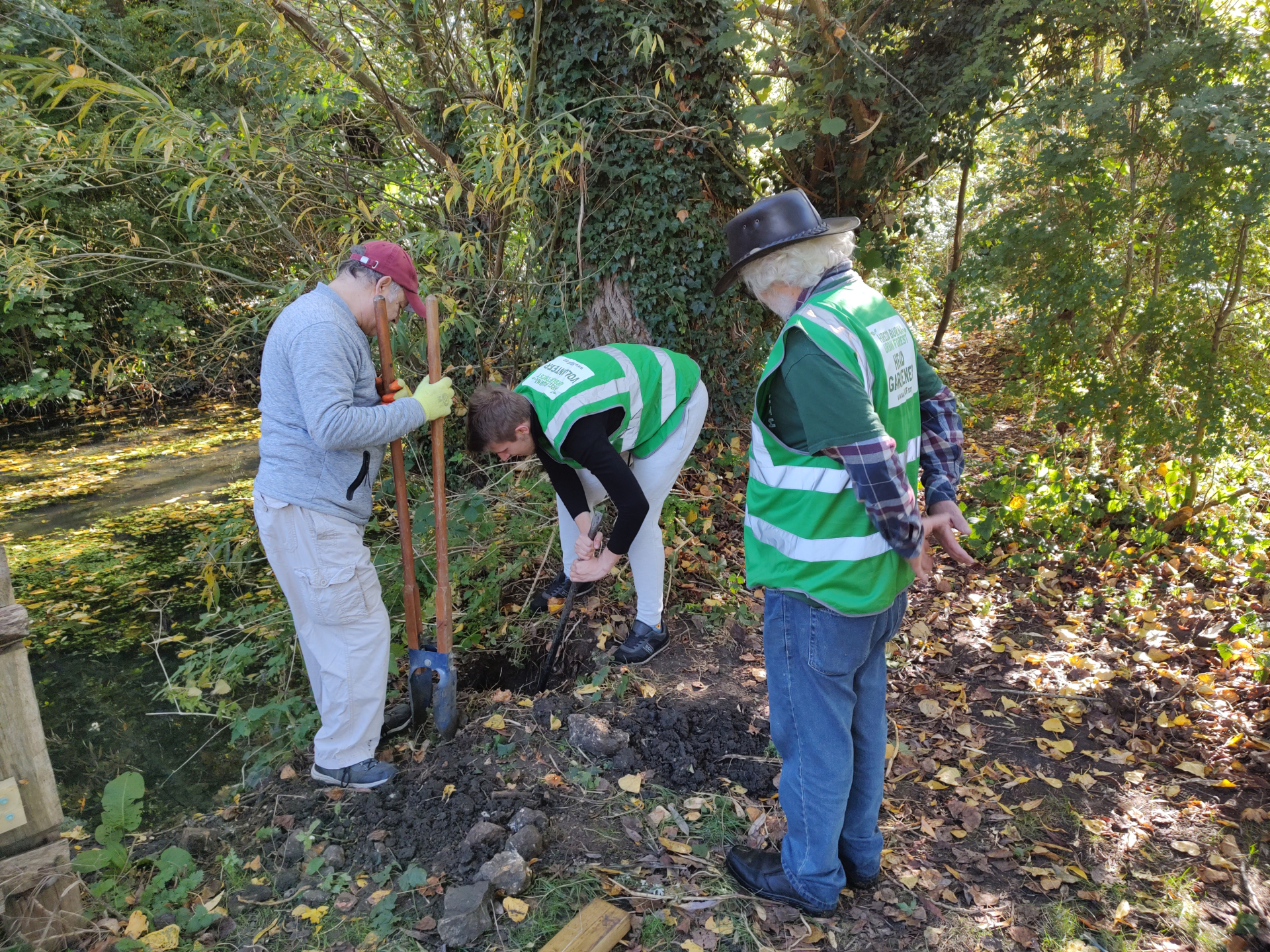
We’ve got a lot to do again this month, with a wide range of jobs that we need your help with across the site. Please join us on our usual outing on the 3rd Sunday of every month between 10 and 12, next event on 25th of April.
Fritillaries in the wildflower meadow
While you’re there, be sure to visit the wildflower meadow, where the fritillaries that we planted last year have started to come up!
As well as the familiar clearance and planting jobs that need doing we have unwanted visitors to evict! The Himalayan Balsam growing along the banks of the stream is an invasive species that’s crowding out native plants and has to go.
Checkout the event for more details of exactly what we’ll be up to and where to meet.
Our work party this month sees us tackling a wide range of jobs. We’ve got chipping, strimming, planting, and all sorts planned. There are even some trees that need to be freed!
We’ll be spread out in a few areas across the site, so everyone can keep distanced. Please RSVP so we know how many are coming and can plan accordingly.
We’re giving our new chipping attachment for the tractor it’s first outing. To make way for our new birch grove we’ve removed a big pile of brambles that need to be chipped.
In the picnic field the trees have outgrown their supports and need to be freed from the rubber bands holding them. In many cases it’s now the trees that are holding the posts up rather than the other way around.
And in the areas that we’ll be clearing there are new trees to go in, as well as the ongoing task of making sure our 2019 plantings are looked after.
Please RSVP so we know how many people are coming and can plan to keep you all safely distanced. We’ll send you details of exactly where to meet and what you might need to bring for the various jobs.
We’re restarting our work parties this month with some more tree-planting.
We will be doing this in a covid-safe way by avoiding meeting as one big group. To help us plan this please register for the event so we know who’s coming.
We will be doing some new planting to replace trees that have been damaged or removed and giving a bit of TLC to our younger saplings. Depending on numbers we may also be doing a bit of litter-picking in some areas.
The planting will be happening on 21st February.
If you’d like us to keep you up to date with the latest events and goings-on at HBUF, why not subscribe to our mailing list? We’ll send you a maximum of one or two emails a month with event details and other news.
On a cold, greyish, misty-moisty morning, a group of fifteen people came together to work. While twelve chose slipping about in the afore-mentioned mud, trying their hands at coppicing, the rest adjourned to the wildflower meadow to finish this year’s planting.
Coppicing is, basically, clearing parts of the woodland in order to create space for the remaining trees to grow into large trees, thus being able to fulfil their potential. There is, paradoxically, a certain amount of cutting trees to the ground that goes on initially, accompanied by tidying away of undergrowth and brush. These trees will not die, however, but will make new growth from the stump.
This took place last Sunday, 6th December 2020, in the adjoining area to that which was begun last year. The plan is then to plant under-storey trees in the areas that have been cleared, for example holly, yew, hazel – sometime soon in the new year, we hope. There will still need to be some clearing up of undergrowth to take place at our first work party of 2021 in January.
While this was taking place in one area, in the wildflower meadow a smaller group of three people finished planting up the fritillaries; the First-Sunday work party in November had planted just over half of the thousand bulbs, together with five hundred wildflower plug plants, comprising field geranium, birds foot trefoil, ox eye daisy, red campion, meadow buttercup, cowslip, common toadflax, field scabious and rough hawkbit (hope I’ve left nothing out). So, next spring, we are hoping for a burgeoning forth of an amazing nature!
Juanjo also managed to capture the day on film
So, all our gratitude goes to our stalwart band of workers, including newcomers Gabby, Juanjo (photographer) and Ian, and then Jason (tree surgeon), his two daughters, Dave, Jake, Kate H, Kate R, Sue, Carol, Bob, Steve and Mary.
For our November work party we had a great morning planting in the wildflower meadow. After a wet week the weather was kind to us on the day itself, and the ground nicely softened up by the rain.
We had a mix of 500 wildflower plug-plants and 1,000 fritillary bulbs to put in, which you’ll be able to lookout for as they flower next year. They’ve been planted in patches across the meadow so we’re hoping for small patches of colour across the field.
It was a fabulous way to while away a Sunday morning.
You can join us on our next work group on the first Sunday in December, when Jason will be leading us in a bit of coppicing. We may also have a few leftover bulbs to put in…
Below are some of the plants we’ve put in so you know what to look for, with links to the rest if you’re interested.
Some of these I recognise from my own garden, I just never knew what they were called until now 🙂
As the fritillary once thrived in flooded hay meadows across middle and southern England, it should be at home in Hreod Burna.
By the time we’re finished, 1,000 bulbs will have been planted, so we’re hoping for an excellent display when they flower in April & May.
Meadow crane’s-bill has hairy stems and saucer-shaped, white, blue or violet flowers about 4cm across. It can be seen in lowland hay meadows, roadside verges and grasslands. It flowers between June and August.
Oxeye Daisy, found in traditional hay meadows and along field margins. Its large blooms appear from July to September and are so bright that they appear to ‘glow’ in the evening, hence the other common names of ‘Moon daisy’ and ‘Moonpenny’.
Below is a list of all the plants we put in this time, with links to the Wildlife Trusts and Royal Horticultural Society web sites if you fancied finding out a bit more.